
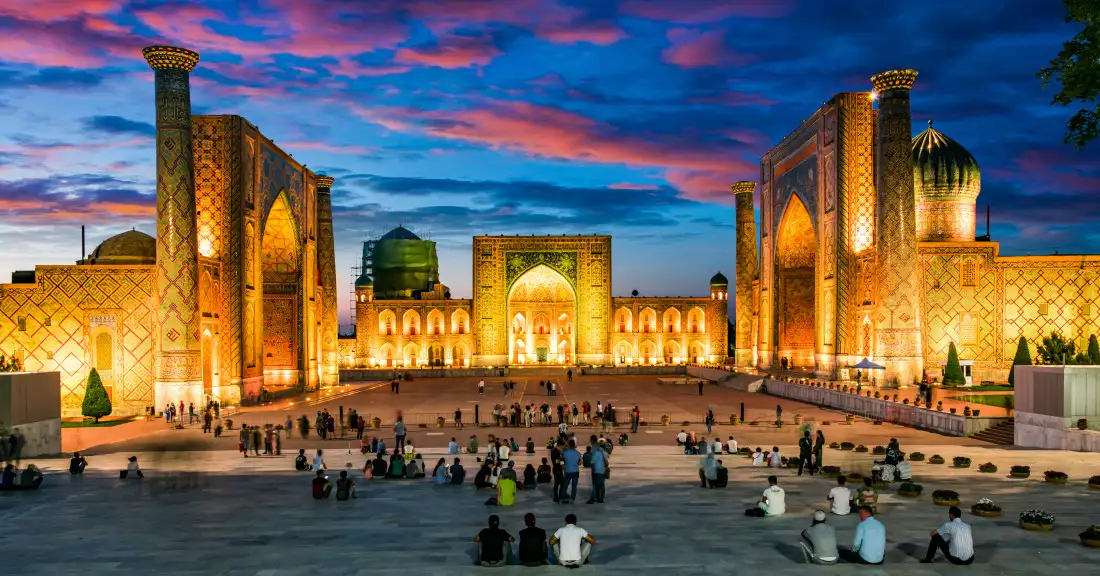
This article provides an overview of Samarkand
This article provides an overview of Samarkand for those keen to explore the possibility of living and working in the city. The information presented is gathered from open sources and is not exhaustive or meant to supplement or substitute legal and professional advice.
Key Facts
- Country: Uzbekistan
- Land area: 1,198 sq km1
- National language: Uzbek
- Currency: Uzbek som/sum/soum
Introduction
Samarkand, the capital and administrative centre of Samarkand Region, is an ancient and historic city located in the Zarafshan Valley in north-eastern Uzbekistan. It is the second largest after Tashkent, capital of Uzbekistan. In the 14th century, Samarkand was the capital of the Timurid dynasty. One of the oldest continuously inhabited cities in Central Asia, Samarkand “has lived through many historical events and upheavals” and was an important city on the Silk Road linking China and the Mediterranean. It was included in UNESCO’s World Heritage List in 2001 as “Samarkand – Crossroads of Cultures”.
Samarkand is well connected with an international airport, located near the city centre, and a railway network that connects to many cities in the country. 2
Demographic profile
As of January 2021, Samarkand has a population of more than 546,000 people.3 In 2019, more than 40 percent (236,200) of its population are employed and almost half (258,500) are economically active. The majority of its population are employed in the eduction and agriculture sectors.4 As with the rest of the country, Uzbek is the main language, although Tajik is also widely used in Samarkand. 5